PowerShell 4.0 Actions
Threat Prevention users or a Netwrix Engineer (through Netwrix Professional Services) can write and assign a PowerShell 4.0 script to a policy. The Enterprise Manager invokes the script when the policy is enabled.

Step 1 – On a policy or template Actions tab, click Add (+) to open the Add Action window.
Step 2 – In the left pane, select the radio button for PowerShell 4.0.
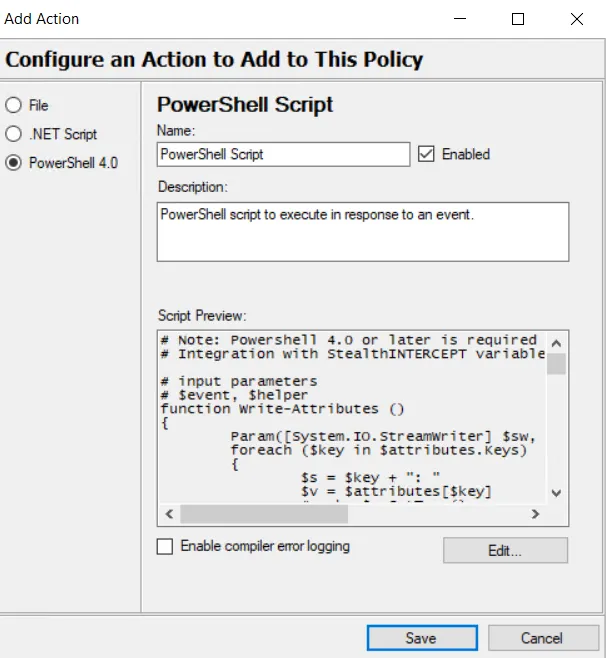
Step 3 – Configure the PowerShell 4.0 Script action:
- Name – Provide a unique, descriptive name for this PowerShell 4.0 action
- Enable the Enabled checkbox to allow the policy to launch the script
- Description – Provide a clear and detailed description for this PowerShell 4.0 action. This is optional but recommended.
- Click Edit… to view the sample script and open the Threat Prevention Script Editor
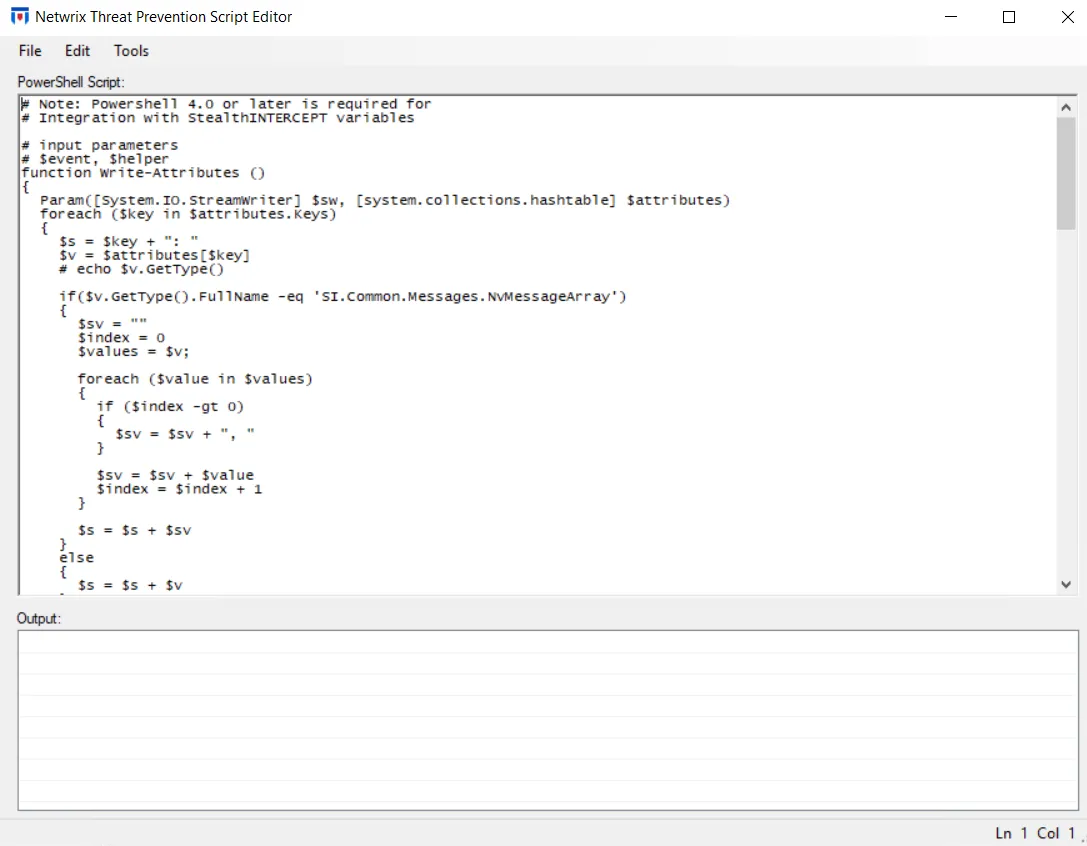
Step 4 – Create or copy/paste the custom script in the Threat Prevention Script Editor. See the Threat Prevention Script Editor Tools topic for additional information, i.e. Run for testing and Encrypt functionality. See the Default PowerShell 4.0 Script topic for the default custom script. Save and close.
Step 5 – On the Add Action window, the system displays the new script in the Script Preview section. Check the Enable compiler error logging checkbox to enable Threat Prevention to log information about the compiling of scripts.
Step 6 – Click Save to close the Add Action window and apply changes.
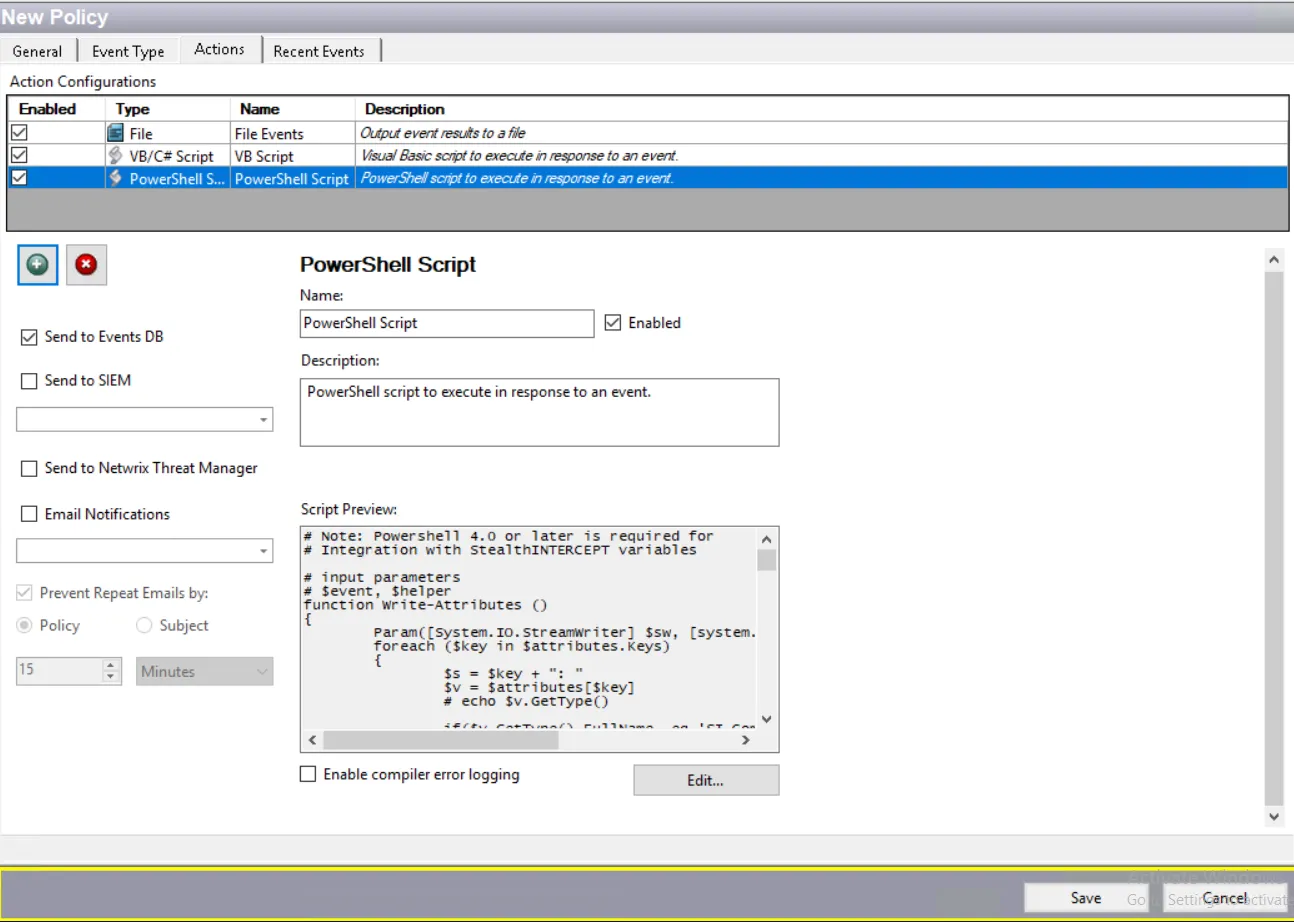
The Actions tab now displays the configured settings for the specified PowerShell 4.0 action. You can also directly edit the action configuration from this display.
Default PowerShell 4.0 Script
The system uses the following PowerShell 4.0 script as a default action. It either creates the c:\nveventdata.txt file or appends the event data to it.
# Note: Powershell 4.0 or later is required for
# Integration with StealthINTERCEPT variables
# input parameters
# $event, $helper
function Write-Attributes ()
{
Param([System.IO.StreamWriter] $sw, [system.collections.hashtable] $attributes)
foreach ($key in $attributes.Keys)
{
$s = $key + ": "
$v = $attributes[$key]
# echo $v.GetType()
if($v.GetType().FullName -eq 'SI.Common.Messages.NvMessageArray')
{
$sv = ""
$index = 0
$values = $v;
foreach ($value in $values)
{
if ($index -gt 0)
{
$sv = $sv + ", "
}
$sv = $sv + $value
$index = $index + 1
}
$s = $s + $sv
}
else
{
$s = $s + $v
}
$sw.WriteLine($s)
}
}
[System.IO.StreamWriter] $sw = $null
Try
{
$sw = New-Object System.IO.StreamWriter ("C:\si_eventdata.txt", $true)
$sw.WriteLine("===========================================")
$sw.WriteLine(("TimeLogged:  " + $helper.TimeLogged.ToString()
$sw.Flush()
$sw.WriteLine(("TimeLoggedUtc:  " + $helper.TimeLoggedUtc.ToString()
$sw.Flush()
$sw.WriteLine(("EventSourceType: " + $helper.EventSourceType))
$sw.Flush()
$sw.WriteLine(("EventSourceName: " + $helper.EventSourceName))
$sw.Flush()
$sw.WriteLine(("SettingName: " + $helper.SettingName))
$sw.WriteLine(("EventName: " + $helper.EventName))
$sw.WriteLine(("DN:  " + $helper.DN.ToString()
$sw.WriteLine(("ClassName: " + $helper.ClassName))
$sw.WriteLine(("Perpetrator: " + $helper.Perpetrator))
$sw.WriteLine(("OriginatingServer: " + $helper.OriginatingServer))
$sw.WriteLine(("OriginatingClient: " + $helper.OriginatingClient))
$sw.WriteLine(("Success: " + $helper.Success.ToString()
$sw.WriteLine(("Status: " + $helper.Status))
$sw.WriteLine(("BlockedEvent: " + $helper.BlockedEvent.ToString()
$sw.WriteLine(("EventsCount: " + $helper.EventsCount.ToString()
$sw.WriteLine(("OriginatingClientProtocol: " + $helper.OriginatingClientProtocol))
$sw.WriteLine(("FromHost: " + $helper.FromHost))
$sw.WriteLine(("FromHostIp: " + $helper.FromHostIp))
$sw.WriteLine(("ToHost: " + $helper.ToHost))
$sw.WriteLine(("ToHostIp: " + $helper.ToHostIp))
$sw.WriteLine(("LoginType: " + $helper.LoginType.ToString()
$sw.WriteLine(("AffectedObjectSid: " + $helper.AffectedObjectSid))
$sw.WriteLine(("OriginatingServerIp: " + $helper.OriginatingServerIp))
$sw.WriteLine(("PerpetratorName: " + $helper.PerpetratorName))
$sw.WriteLine(("PerpetratorSid: " + $helper.PerpetratorSid))
$sw.WriteLine(("EventNameTranslated: " + $helper.EventNameTranslated))
$sw.Flush()
$sw.WriteLine("")
$sw.WriteLine("New Attributes:")
$sw.WriteLine("--------------")
Write-Attributes -sw $sw -attributes $helper.NewAttributes
$sw.WriteLine("")
$sw.WriteLine("Old Attributes:")
$sw.WriteLine("--------------")
Write-Attributes -sw $sw -attributes $helper.OldAttributes
$sw.WriteLine("")
$sw.WriteLine("Operations:")
$sw.WriteLine("--------------")
Write-Attributes -sw $sw -attributes $helper.Operations
$sw.WriteLine("===========================================")
$sw.WriteLine("")
$sw.Flush()
$sw.Close()
}
Catch
{
echo $_.Exception.GetType().FullName, $_.Exception.Message
if($sw)
{
$sw.WriteLine("Exception")
$sw.WriteLine($_.Exception.GetType().FullName, $_.Exception.Message)
$sw.Flush()
$sw.Close()
}
}