Backup and Recovery Solutions
Implementing effective backup and recovery solutions is essential for safeguarding your system data and ensuring operational continuity. This section covers the key methods for performing system backups, restoring data, and managing migrations.
System Backup
The System Backup feature lets you create and manage comprehensive backups of your system. You can perform backups, restore previous versions, and set up automatic routines using the web interface or administrative console to ensure your data stays protected.
Migration readiness checklist (preflight validation)
Before creating a migration backup and restoring it on a new Endpoint Protector Server, validate the following items to avoid failed imports/restores:
Source appliance (current server)
- Ensure you can successfully create a System Backup (Migration) and that you securely save the System Backup Key (required for restore).
- Download any previous System Backups or Audit Log Backups you want to keep (these aren't preserved through the migration process).
- Confirm the resulting backup file is within the supported size limits (see the note in the following section). If it isn't, contact Customer Support before proceeding.
Target appliance (new server)
- Deploy the new Endpoint Protector Server on a newer version than the source (migration restore is intended for a newer server version).
- Ensure the new appliance has enough free disk space for the restore operation (backup file + temporary restore data).
- Plan the cutover: after restore, power off the old appliance and reassign its IP to the new one so existing clients reconnect.
If your migration involves upgrading the server from a pre-5206 version to 5.7.0.0, database partitions must be enabled before the upgrade. Contact Customer Support for assistance.
Creating a System Backup (Migration)
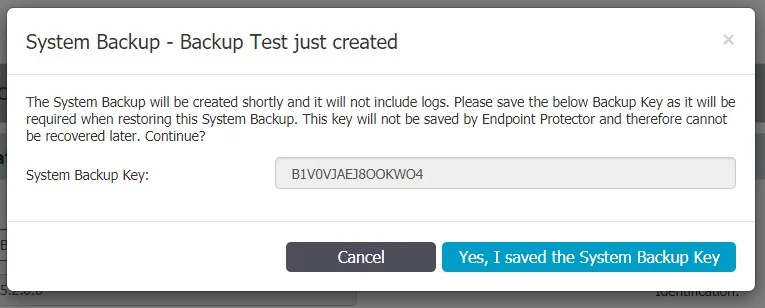
You can create a new migration backup from the System Maintenance, System Backup section.

For security purposes, the System Backup Key will not be stored by the Endpoint Protector. Before proceeding, ensure it is properly saved.
Importing and Restore (Migrate)
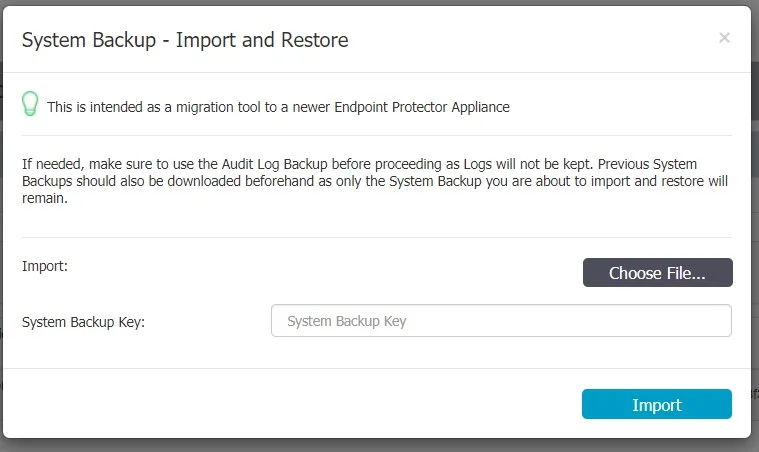
You can restore a backup on the same Endpoint Protector Server. However, the primary use case is to import and restore the backup on a newer Endpoint Protector Server (e.g., version higher than 5.2.0.6).
The migration process of a System Backup requires the backup file and System Backup Key.
If needed, download previous System Backups or Audit Log Backups before this step, as they will not be kept in process.
After the Import and Restore (Migration) has been made to the new Appliance, the old Appliance should be turned off. Its IP would then have to be reassigned to the new Appliance in order for the deployed Endpoint Protector Clients to start communicating with the new Appliance.
Backup Scheduler
The Backup Scheduler lets you configure automatic, recurring backups without manual intervention. You can access it from System Maintenance > System Backup, next to the Import and Restore (Migrate) option.
To configure the Backup Scheduler:
-
Go to System Maintenance > System Backup > Backup Scheduler.
-
Enable the scheduler.
-
Configure the backup frequency and retention settings.
-
Enter a Backup Key. This key is used for all scheduled backups.
noteA single backup key is used for all scheduled backups. Store this key securely — you'll need it to restore any backup created by the scheduler.
-
Click Save to apply the schedule.
Scheduled backups run automatically based on the configured frequency. You can view the status and history of scheduled backups in the List of Backups table.
Once deleted, a backup can't be recovered.
The Endpoint Protector Server can't process backup files larger than 200 MB. If a created backup file exceeds this limit, contact Customer Support for assistance.
eDiscovery logs aren't included in the Audit Log Backup. eDiscovery scan results are exported through the Reports and Analysis > Export Logs section. When a scan action is set to "Stop and Clear Logs", eDiscovery logs are automatically exported to the Export Log List before deletion.